Why Boredom Is Good for Kids
"I'm bored" might be one of the most dreaded phrases in parenting. Here's what child development research actually says about why that discomfort is doing your kid a favor — and why it's so hard for us to just let it happen.
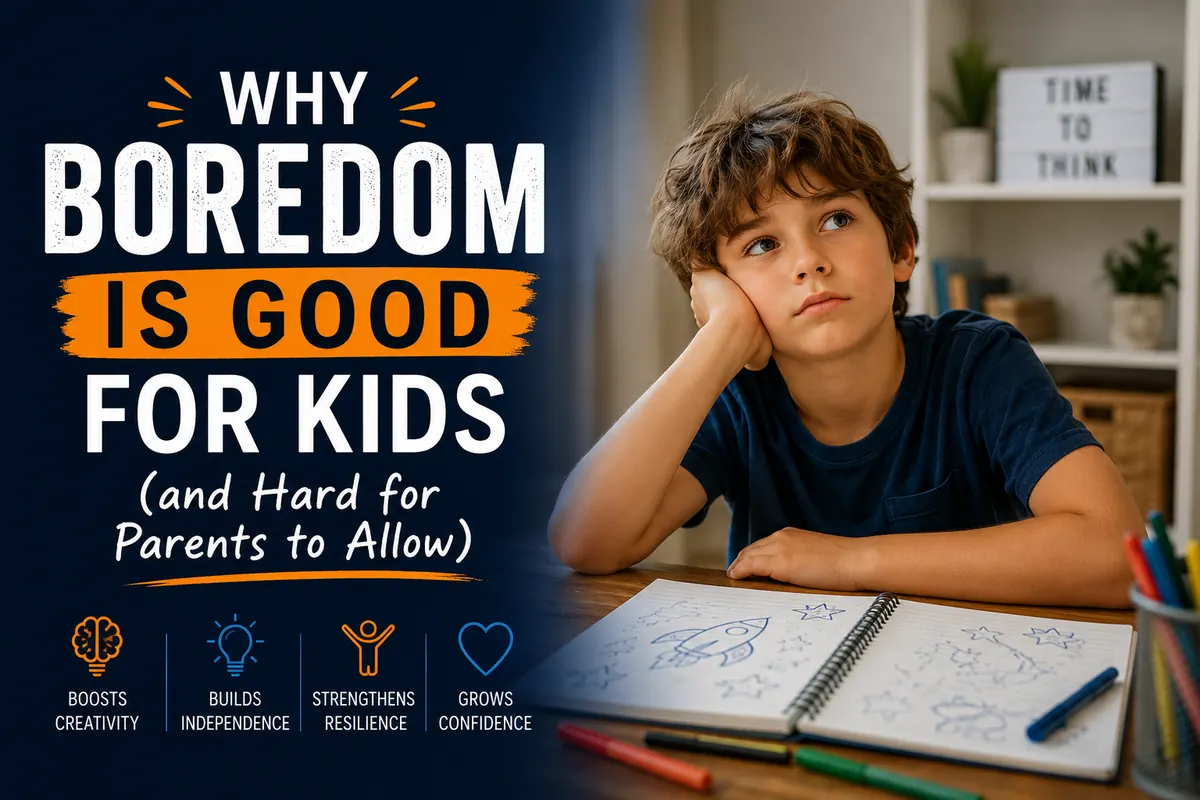
It's a quiet Saturday afternoon. No practice, no lesson, nothing on the calendar. And within twenty minutes, you hear it: "I'm bored." Something in a parent's chest tightens at those words. There's an almost automatic pull to fix it — hand over a tablet, suggest an activity, list off the toys sitting untouched in the next room. Boredom feels like a problem. A gap in the day that needs filling, a sign that something isn't working.
But according to a growing body of child development research, that instinct to rescue kids from boredom might be getting in the way of something valuable. The Child Mind Institute, a national nonprofit focused on children's mental health, describes boredom as an opportunity rather than a problem to solve — one that helps kids build frustration tolerance, planning skills, and problem-solving ability, precisely because nobody is stepping in to solve it for them.
This isn't a call to eliminate every activity or stop engaging with your kids. It's a case for something much smaller and, for a lot of parents, much harder: leaving a little unscheduled, unentertained time on the calendar, and resisting the urge to fill it the moment it starts to feel uncomfortable.
In This Article
What Actually Happens in a Bored Brain
Boredom isn't the absence of brain activity — it's closely tied to one of the most active systems the brain has. Researchers at Building Brains Together, a child development organization, note that boredom activates what neuroscientists call the default mode network — the same system responsible for daydreaming, imagination, and reflection. When this network is active, the brain isn't idling. It's making connections, reprocessing memories, and quietly working through problems in the background.
This reframes what a child actually means when they say "I'm bored." According to the nonprofit Good Inside, that phrase usually translates to something closer to "my brain doesn't know what to do next" — which sounds like a complaint, but is actually the exact starting point where creativity and self-directed problem-solving begin. The discomfort is the first step, not a sign that something has gone wrong.
When a parent steps in the moment boredom appears, the child never gets to the part where their own brain generates an answer. The rescue, however well-intentioned, removes the exact discomfort that was about to become useful.
What the Research Shows
The link between boredom and creativity has been studied directly, not just theorized. A widely cited 2014 study from the University of Central Lancashire, conducted by psychologist Dr. Sandi Mann, found that people who first completed a boring task — such as copying numbers from a phone book — performed better on a subsequent creative problem-solving challenge than people who hadn't been bored first. The boredom itself appeared to prime the brain to seek out novelty and generate new ideas once given the chance.
Curiosity researcher Jamie Jirout at the University of Virginia's School of Education and Human Development has found that stretches of safe, unstructured time give children's natural curiosity room to develop, which in turn drives creativity and deeper engagement with the world around them. Her research suggests that the space boredom creates — not any specific activity that fills it — is what does the developmental work.
Beyond creativity, boredom appears to build a skill that's arguably even more valuable long-term: the ability to tolerate discomfort without immediately needing it fixed. The Child Mind Institute notes that learning to sit with boredom helps children develop patience and frustration tolerance — the same emotional regulation skills that matter well beyond childhood, in situations where instant gratification simply isn't available.
What Unfilled Time Tends to Build
- Creative problem-solving and original thinking
- Frustration tolerance and patience
- Self-directed play and initiative
- Planning and follow-through skills
What Constant Entertainment Can Crowd Out
- The chance to generate your own ideas, not borrowed ones
- Practice tolerating an uncomfortable feeling
- Confidence in your own ability to self-direct
- The mental rest that comes with true downtime
Why It's So Hard for Parents to Allow
Knowing the research doesn't make the moment any easier. A bored, restless kid is genuinely uncomfortable to be around, and a parent's instinct to soothe that discomfort — in their child and, honestly, in themselves — is strong and completely understandable. There's also a cultural undercurrent that treats every idle moment as wasted potential, as though a child's time should always be optimized toward something visibly productive.
Part of what makes this hard is that the payoff isn't immediate. A parent who hands over a tablet gets peace within seconds. A parent who says "figure it out" might get whining, complaining, or a flat "there's nothing to do" for several long minutes before anything resembling creativity shows up. Waiting through that stretch requires tolerating your own discomfort right alongside your child's — which is, in its own way, exactly the same skill boredom is meant to teach them.
Boredom vs. the Quick Screen Fix
Screens are the single fastest and most available boredom antidote in most households, which makes them worth addressing directly. This isn't an argument that all screen time is harmful — but research on child creativity does point to a meaningful distinction between passive digital entertainment and the kind of open-ended, self-generated play that boredom tends to produce.
Because digital media is designed to be maximally engaging, it removes the exact discomfort that would otherwise push a child toward inventing their own game, story, or activity. The gap simply gets filled by someone else's content instead of the child's own imagination. That's not a moral failing on any parent's part — it's just worth naming, since it's the single biggest reason unstructured boredom has become rarer for this generation of kids than for previous ones.
How Different Downtime Activities Tend to Compare
What This Looks Like at Different Ages
Boredom tolerance isn't something kids either have or don't — it's a skill that develops gradually and looks different depending on age. Younger children generally need more initial support learning how to move through boredom, while older kids and teens are more capable of sitting with it independently, even if they're equally likely to complain about it.
Younger children (roughly ages 3–7)
May need a small nudge to get started — a simple prompt like "what could you build with that box?" — without the parent fully designing or joining the activity. The goal is a spark, not a finished plan.
Elementary-age children (roughly ages 8–11)
Are typically capable of generating their own ideas with minimal prompting, though they may still test the waters by complaining first. This is often the age where longer stretches of unstructured time pay off the most visibly.
Tweens and teens
Often default to a phone as the fastest fix for boredom, which makes intentional screen-free stretches more of a deliberate choice than something that happens naturally. Framing it as "protected downtime" rather than a punishment tends to go over better than a blanket restriction.
How to Actually Let Boredom Happen
Allowing boredom isn't about doing nothing as a parent — it's about resisting a specific kind of intervention: solving the boredom for your child instead of letting them sit with it long enough to solve it themselves.
Protect some genuinely unscheduled time
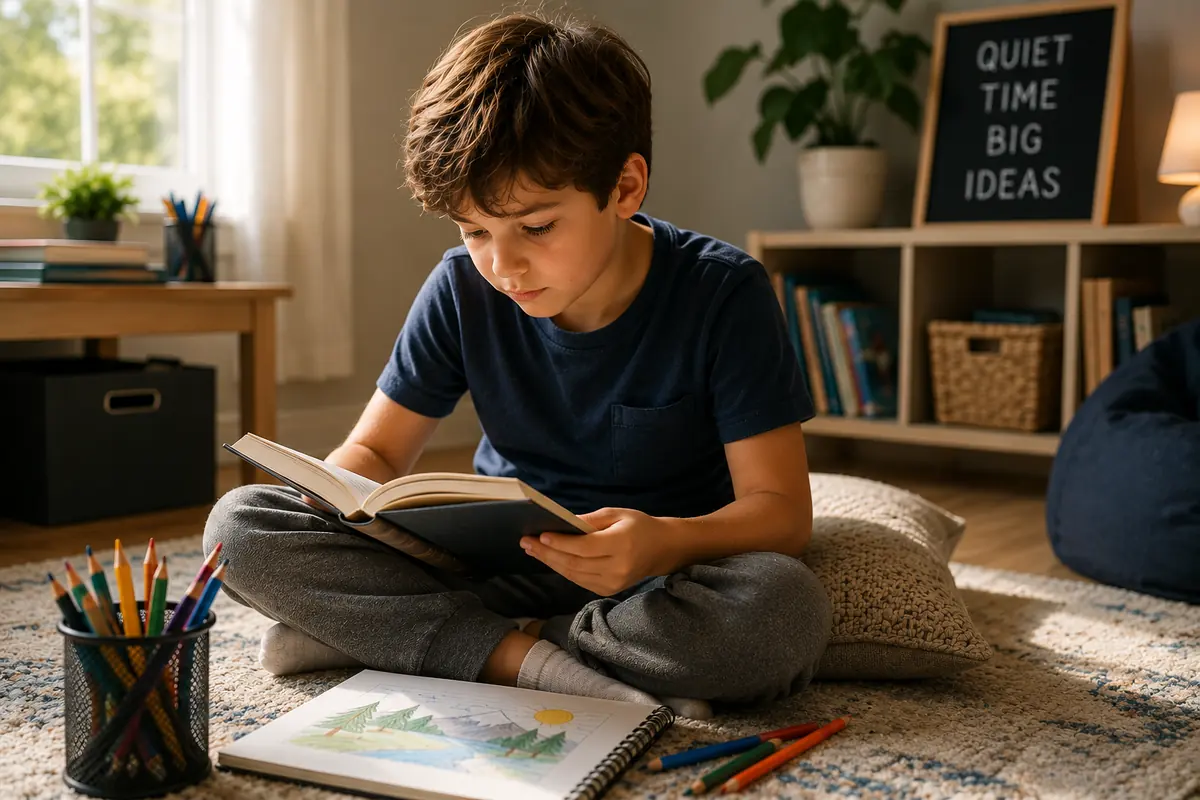
A stretch of the week — even just an afternoon — with nothing planned and no screen defaulted to gives boredom room to actually show up in the first place.
Resist the urge to fix it immediately
When "I'm bored" arrives, try waiting before offering a solution. A short pause, even just a few minutes, gives a child's own ideas a chance to surface before an adult's does.
Offer materials, not entertainment
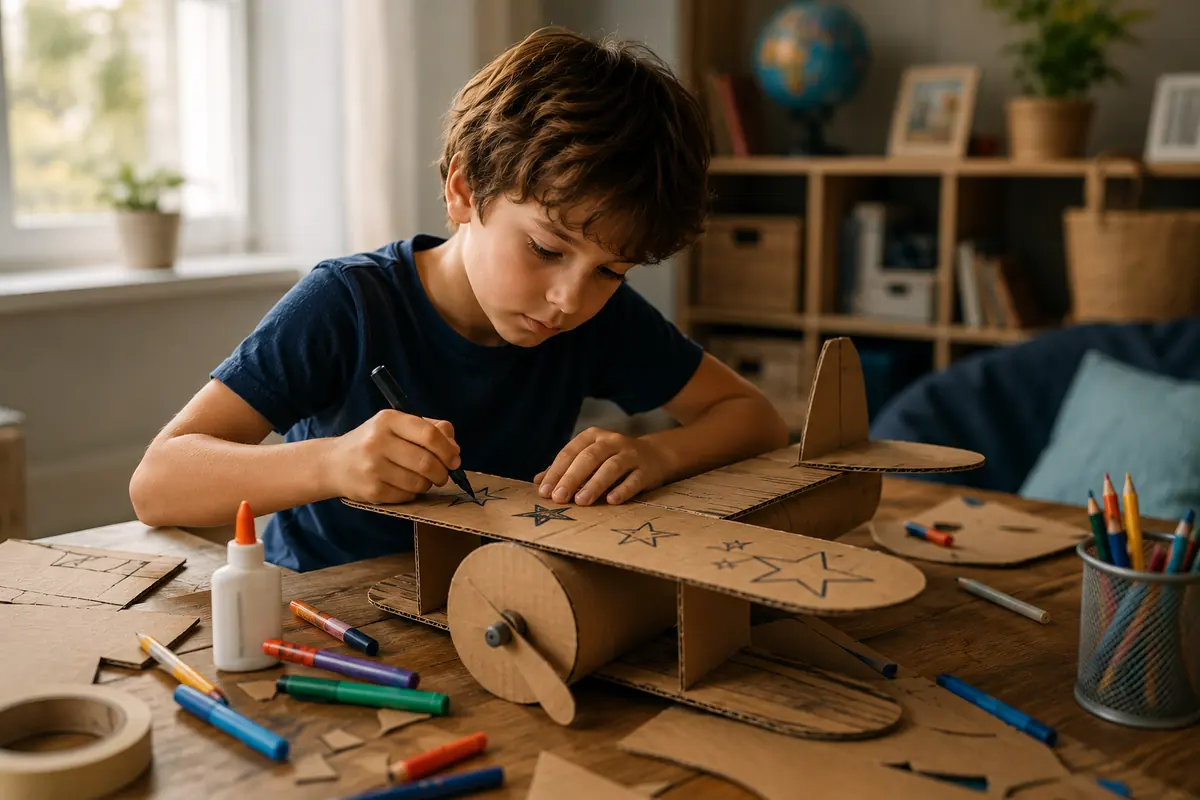
Simple, open-ended supplies — art materials, blocks, a cardboard box — invite a child to generate their own activity, unlike a fully designed game or screen that does the inventing for them.
Expect some initial resistance
The first response to unfilled time is often complaining, not creativity. That's a normal part of the process, not a sign that the approach isn't working.
What to Say When They Complain
The way a parent responds to "I'm bored" matters as much as whether they intervene at all. A dismissive response can feel uncaring, while an overly solution-focused one removes the child's chance to work through it themselves. The middle ground — acknowledging the feeling without immediately fixing it — tends to work best.
"Boredom feels kind of uncomfortable, doesn't it? I bet you'll figure out something interesting to do." This acknowledges the feeling as real without treating it as an emergency, and it quietly signals confidence in your child's own ability to work through it.
For kids who are more used to being entertained, this shift can take some time. It's reasonable to expect a period of adjustment before self-directed play starts to feel natural rather than like a punishment — patience during that transition matters as much as the approach itself.
What This Isn't Saying
None of this is an argument against activities, structure, or engaged parenting — plenty of research, including on the benefits of organized extracurriculars, supports the real value of structured time too. It's also not a suggestion to leave young children unsupervised or to ignore genuine, prolonged distress, which is different from ordinary boredom. The point is narrower and more specific: somewhere in a full schedule, it's worth protecting real space for nothing to be planned at all.
Frequently Asked Questions
Isn't boredom just a sign my child needs more to do?
Not necessarily. Research suggests boredom is often the starting point for creativity and self-directed play, rather than evidence that a child's life lacks enough activities.
How long should I let my child be bored before stepping in?
There's no fixed rule, but giving it more than the first few minutes — past the initial complaining — tends to be where self-generated ideas start to appear. Trust your judgment about your specific child's temperament.
Is screen time always the "wrong" answer to boredom?
Not always, but passive screen time tends to short-circuit the self-directed thinking that boredom would otherwise produce. Occasional screen time isn't harmful on its own — the concern is boredom never being allowed to happen because a screen is always the default fix.
My child genuinely struggles to entertain themselves — is that different from normal boredom?
Some children, including those with ADHD, may find it harder to occupy themselves for extended periods. These children may need more initial scaffolding and shorter stretches of unstructured time to start, building up gradually rather than all at once.
Does this apply to teenagers too, or just younger kids?
It applies across ages, though it looks different — teens are generally capable of tolerating boredom well, but often default to a phone as the fastest fix, which means protecting unstructured, screen-free time becomes more of a deliberate choice.