Should Kids Still Have Homework?
A growing number of parents believe homework should disappear completely. Others say it remains essential for practice, discipline, and academic success. The research points to a more useful answer: homework is valuable only when the assignment, amount, and age of the student are right.

The homework debate has returned with unusual intensity. Recent national reporting from Education Week shows that schools and teachers are still reexamining why homework is assigned, how often students receive it, and whether traditional take-home work remains the best way to reinforce learning. Parents are asking the same question at home: after a full school day, does another hour at the kitchen table genuinely improve learning?
The disagreement is not simply about whether children enjoy homework. Parents regularly describe children spending hours on assignments, adults being forced to reteach lessons, and family time turning into nightly conflict. A Johns Hopkins University discussion of homework makes a similar distinction: homework can remain valuable, but only when teachers design it thoughtfully and connect it to a clear instructional purpose. Families facing persistent homework stress can also review our parent education guides for practical strategies on study habits, confidence, and school support. Teachers raise the opposite concern: class periods are limited, many students need additional practice, and essential skills cannot always be mastered through one explanation during the school day.
The truth is more useful than either extreme. Homework is not automatically beneficial, and it is not automatically harmful. Its value depends on the student’s age, the purpose of the assignment, the amount of time required, the quality of the work, and whether the student receives feedback. The better question is not, “Should children have homework?” It is: “Is this particular homework helping this student learn?”
In This Article
Why Parents Are Questioning Homework Right Now
Homework has always inspired complaints, but today’s debate is about more than children simply disliking assignments. Families are balancing long school days, commuting, sports, activities, multiple children, digital grade portals, and greater pressure surrounding academic performance. In many homes, the parent is no longer simply asking whether homework is finished. The parent is checking several platforms, monitoring missing work, interpreting instructions, finding materials, photographing assignments, and negotiating every step.
Parents also see a fairness problem. One student may have a quiet desk, a highly educated adult nearby, fast internet, and paid academic support. Another may be caring for siblings, sharing a room, or completing work without anyone available to explain confusing directions. When an assignment requires significant help at home, the final grade may measure family resources as much as student understanding.
Teachers are responding to a different reality. Mathematics, reading, writing, vocabulary, music, languages, and test preparation all require practice. A 2026 Education Week survey found that educators continue to assign homework for a range of reasons, including building knowledge, reinforcing concepts, and developing responsibility. That is why effective subject tutoring should reinforce classroom learning rather than simply complete assignments. A teacher may introduce a method during class but still need students to apply it independently. Teachers also know that students who never practice outside class may enter more advanced courses without the stamina or study habits those courses require.
Parents are right that a child’s entire evening should not become an extension of school. Teachers are right that many important skills require practice. The solution is not unlimited homework or no homework at all. It is purposeful work in a reasonable amount.

What the Research Actually Says About Homework
One of the best-known research syntheses on homework was led by Duke University professor Harris Cooper. As summarized by Duke University, the review found a positive relationship between homework and academic achievement, but the relationship was much stronger for students in grades 7–12 than for students in elementary school. This age difference remains one of the most important findings in the homework debate.
A 2024 systematic review indexed by PubMed found that students who completed homework generally performed better academically than those who did not, with particularly notable results in arithmetic computation and problem solving. The full review, available through the National Library of Medicine, also cautions that excessive homework can increase cognitive load, mental fatigue, boredom, and reduced motivation. The ideal duration therefore remains unclear and should not be treated as a universal number.
Parents should also understand that much of the homework research is correlational. Students who regularly complete homework may also be more organized, motivated, supported, or academically prepared. The Campbell Collaboration evidence summary likewise emphasizes that homework effects vary by grade level, subject, and the way time is measured. Time spent is not the same as learning gained. One student may complete twenty minutes of focused practice independently, while another spends ninety minutes confused, distracted, or repeating the wrong method.
What the Evidence Supports
- Homework tends to show greater academic value in secondary school
- Purpose and assignment quality matter
- Practice can strengthen skills already taught
- Feedback makes independent work more useful
- Reasonable limits protect focus and motivation
What Research Does Not Prove
- Every student needs homework every night
- More homework always creates more achievement
- Long assignments are automatically more rigorous
- Parents should teach new material at home
- One homework policy works equally well at every age
When Homework Actually Helps Students Learn
Effective homework usually reinforces a skill the teacher has already introduced. The student understands what the assignment is asking, can begin without an extended argument, and can complete most of the work independently. The task has a clear purpose: practice a method, retrieve important information, read attentively, revise writing, prepare for a discussion, or study for an assessment.
Well-designed homework also gives teachers useful information. If students complete several problems independently, the teacher can see which concepts are secure and which errors need attention. The assignment becomes part of the instructional cycle: teach, practice, review, correct, and apply again.
It reinforces something already taught
Independent work should follow instruction. A parent should not need to introduce an entirely new mathematical method or writing concept.
It has one clear purpose
Ten focused problems practicing one skill are often more useful than a long packet mixing unrelated topics without explanation.
It matches the student’s level
Useful practice should require thought without placing the entire assignment beyond the student’s current ability.
The student receives feedback
Practice becomes more valuable when mistakes are reviewed and students learn how to correct their reasoning.
Practice Matters—but Volume Is Not the Same as Practice
Students do not become fluent in algebra, reading comprehension, essay writing, vocabulary, or grammar through explanation alone. Focused math tutoring and English tutoring work best when students actively practice, explain their reasoning, and correct mistakes. Learning strengthens when a student retrieves a method, attempts it independently, identifies an error, and tries again. That kind of deliberate practice is valuable.
However, repeating an error twenty times can strengthen the wrong method. Completing easy questions without thinking can create the appearance of productivity without meaningful growth. The strongest practice is targeted, appropriately challenging, and followed by correction.
Reading at Home Is Different From a Worksheet
Regular reading deserves special consideration. Reading builds vocabulary, background knowledge, fluency, attention, and familiarity with language. For younger children, a calm reading routine—independent reading, shared reading, or being read to—may be considerably more valuable than a large packet of disconnected exercises.
When Homework Stops Teaching and Starts Hurting
Homework becomes counterproductive when it repeatedly displaces sleep, movement, family connection, or emotional recovery after school. A widely cited meta-analysis indexed by PubMed found that insufficient sleep, poor sleep quality, and sleepiness are associated with weaker learning, memory, and school performance in children and adolescents. Occasional frustration is normal. Nightly distress is not proof that an assignment is building discipline. It is information that the amount, level, instructions, or support structure may need to change.
Six warning signs that homework is no longer productive
- The student cannot begin without extensive parent explanation
- A short assignment regularly consumes most of the evening
- The parent is rewriting, correcting, or completing the work
- The student repeatedly sacrifices sleep to finish
- Assignments are completed but mistakes receive no feedback
- The work emphasizes copying or compliance rather than understanding
A task intended to take thirty minutes may last two hours because the student has a missing foundational skill, misunderstood the instructions, struggles to sustain attention, or feels compelled to make every answer perfect. Research on adolescent homework habits also shows that media multitasking during homework is associated with weaker executive functioning and lower academic achievement, which is another reason phones and unrelated tabs should be removed during focused work. In that situation, telling the child to “try harder” does not identify the problem.
Homework can also damage independence when adults become too involved. A meta-analysis of parental homework help found that greater levels of direct homework help were associated with lower academic achievement, reinforcing the importance of supporting the process without taking over the work. If a parent explains every step, fixes every sentence, or checks every answer, the finished product no longer shows what the student understands. The child may receive a higher grade while becoming more dependent on help.
Helpful Homework vs Homework That Only Creates Work
The amount of paper is not a reliable measure of academic rigor. The more useful question is whether the student is mentally active and whether the assignment produces information, practice, or understanding that can be used later.
Estimated Learning Value by Assignment Type
How Homework Should Change With a Child’s Age
A reasonable assignment for a high school student may be developmentally inappropriate for a seven-year-old. No chart can account for every child, but the type of work and level of independence should change as students mature.
Grades 9–12
Older students are more likely to benefit from independent problem-solving, sustained reading, essays, test review, laboratory preparation, and long-term projects. Even at this level, however, chronic sleep loss and hours of repetitive work should not be confused with academic excellence.
What About the “10-Minute Rule”?
A widely repeated guideline suggests approximately ten minutes of homework per grade level each night. Duke University’s summary of Harris Cooper’s research describes this “10-minute rule” as a commonly used benchmark, not a guarantee that every child should receive that exact amount. Under that rule, a third grader might receive around thirty minutes and a tenth grader about one hundred minutes. It can serve as a rough warning system, but it is not a scientific guarantee of the ideal amount for every student.
The rule can also hide an important difference between assigned time and actual time. A teacher may design a twenty-minute review, while a student with a missing foundational skill needs more than an hour. Parents should track the child’s actual experience, not only the expected duration.
Simple Parent Rules for Healthier Homework
Parents do not need to choose between doing nothing and supervising every answer. The best approach creates structure while preserving the student’s responsibility. Our approach to personalized tutoring follows the same principle: give students the support they need while steadily building independence.
Allow a short reset after school
Food, movement, conversation, or quiet time can help the student transition before beginning another period of focused work.
Make a brief plan before starting
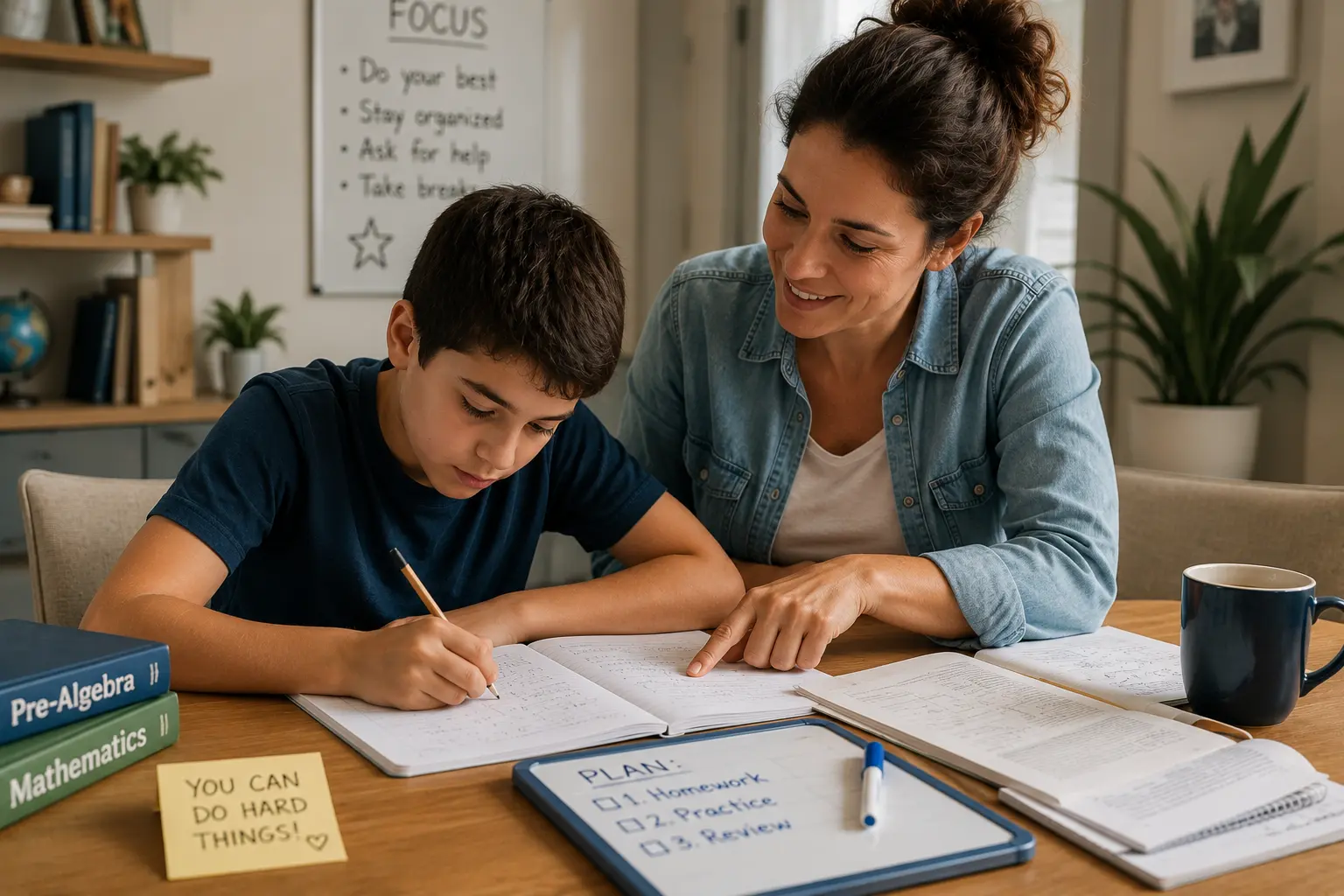
List assignments, estimate time, choose an order, and identify anything that may require clarification.
Use focused work blocks
Remove the phone, use a timer, take brief breaks, and address confusion before it grows into an hour of avoidance.
Help with the process, not the answers
Parents can clarify directions or divide a project into steps while keeping the actual reading, writing, and problem-solving with the student.
Stop after a reasonable amount of focused effort
If an assignment is taking dramatically longer than expected, document the time and ask the teacher how the situation should be handled.
“Show me what the teacher is asking you to do. Tell me which part you understand and where you became stuck. I will help you make a plan, but I am not going to do the thinking for you.”
How to Speak With a Teacher About Too Much Homework
Parents sometimes wait until they are furious before contacting the school. A more productive conversation begins with specific observations and a shared goal: helping the student become independent. Parents who need help identifying the exact academic difficulty can schedule a free consultation before deciding what kind of support is appropriate.
Parent email template
Hello [Teacher’s Name], I wanted to share what we are noticing during homework. The recent assignments appear to be designed for approximately [estimated time], but [student’s name] has needed about [actual time] and significant help to complete them. The main difficulty seems to be [specific skill or instruction]. Could you let us know how long students are expected to work and what you would prefer us to do if that time is reached? We want to support the class expectations while helping [student’s name] become more independent.
This message avoids accusing the teacher of assigning too much before understanding the situation. It may reveal that the student misunderstood the directions, missed a foundational concept, is using an inefficient strategy, or is completing optional work as though it were required.
- How long should this assignment reasonably take?
- Should my child stop after that amount of focused effort?
- How much parent help do you expect?
- What skill is this assignment intended to reinforce?
Homework Help Is Not the Same as Effective Tutoring
A student may finish every assignment and still fail to develop independent skills. This happens when tutoring becomes an emergency homework-completion service: the tutor guides every answer, the student fills the boxes, and the session ends when the assignment is submitted.
Effective tutoring uses homework diagnostically. A strong tutor notices why the student became stuck, teaches the missing concept, models a strategy, and gradually removes support. The goal is not merely to rescue tonight’s grade. It is to make tomorrow’s assignment more manageable without rescue.
Homework Rescue
- Focuses only on completing tonight’s assignment
- Provides constant hints or answers
- Leaves the student dependent on help
- Hides the underlying skill gap
Skill-Building Tutoring
- Identifies the precise point of confusion
- Rebuilds missing foundational knowledge
- Teaches strategies the student can reuse
- Moves the student toward independence
At Academy of Tutoring, personalized instruction is built around the student’s actual needs—not simply the next assignment due. Effective support may include math tutoring, English and writing instruction, test preparation, organization, and study-skills coaching. The goal is to identify the reason a student is struggling and build the skills needed for greater independence.
Final Thought: The Goal Is Learning, Not Merely Completion
Children should still have homework in some situations. Purposeful practice can reinforce lessons, reveal misunderstandings, develop study habits, and prepare older students for advanced academic work. But homework loses its value when it introduces material the student was never taught, requires extensive parent involvement, rewards repetition over understanding, or consumes the entire evening.
Parents do not need to defend every assignment or reject every assignment. They need to observe their child, understand the purpose of the work, communicate with teachers, and protect the conditions in which learning happens.
Frequently Asked Questions
Is homework beneficial for elementary school students?
The relationship between homework and achievement is less consistent in elementary school than in secondary school. Young students may benefit from brief, purposeful practice and regular reading, but long nightly assignments are unlikely to be the best use of their time.
How much homework should a child have each night?
There is no perfect universal amount. The ten-minutes-per-grade guideline can be a rough reference, but parents should also consider actual time, focus, difficulty, sleep, and the combined workload across subjects.
Should parents correct homework before it is submitted?
Parents can encourage students to check directions and review their reasoning, but correcting every error can hide what the student understands. Teachers need an accurate picture of the student’s independent performance.
What should I do when homework takes hours?
Track how long the student works with reasonable focus, note where the difficulty begins, and contact the teacher with specific information. Ask how long the assignment should take and what the teacher wants the student to do once that limit is reached.
Does homework teach responsibility?
Homework can provide opportunities to practice planning and follow-through, particularly for older students. Responsibility develops from appropriate expectations and gradual independence—not simply from assigning a larger volume of work.
Can tutoring reduce homework stress?
Yes, when tutoring identifies the underlying skill gap, teaches organization, and reduces dependence on step-by-step help. Good tutoring should make future assignments more manageable, not merely complete tonight’s work.