
Private Digital SAT Preparation
Reading & Writing + Math
Turn an SAT Score Into a Strategic Growth Plan.
Personalized SAT tutoring built around the student’s baseline score, weakest skill domains, pacing habits, and college goals—not a generic class or a stack of disconnected practice questions.
✓ One-on-one SAT instruction
✓ Bluebook practice analysis
✓ Reading, Writing, and Math
DIGITAL SAT SCORE RANGE
400—1600
EXAMPLE GOAL
1300
from 1100
ILLUSTRATIVE TARGET
+200 Points
See the Distance Between the Current Score and the Goal.
Enter a baseline and target score to visualize the point increase required. This is a planning tool—not a score guarantee.
PERSONALIZED PLANNING
The right timeline depends on the baseline, section breakdown, test date, consistency, and academic foundation.
POINTS NEEDED
+200
A substantial score-growth goal
Baseline
Skill Repair
Timed Accuracy
Target Range
ILLUSTRATIVE PREPARATION ESTIMATE
Estimated lessons and study hours
This estimate adjusts to the selected score gap. It is a planning guide, not a guarantee.
Precision
Major Growth
More Practice Is Not Always Better Practice.
Students often repeat full tests without identifying the patterns behind missed questions. Strategic preparation turns every mistake into a specific instructional priority.
Content Gaps
Missing grammar rules, algebra skills, vocabulary knowledge, or reading strategies repeatedly cost points.
SkillWhat the student does not yet know
Pacing Losses
Students may understand the content but spend too long on difficult questions and rush through attainable points.
TimeWhere minutes are being lost
Repeated Error Patterns
Careless mistakes are rarely random. They usually follow predictable habits that can be identified and corrected.
PatternWhy the same mistakes keep returning
A Score Increase Becomes More Realistic When It Is Divided Into Specific Gains.
This example shows how a 200-point goal might be divided across Reading and Writing and Math. It is an illustration, not a promise of results.
14001300120011001000
1100Baseline
1160Foundation
1230Accuracy
1300Target
Week 1Week 3Week 6Week 8+
Grammar, rhetorical synthesis, vocabulary in context, inference, evidence, and pacing.
Algebra, advanced math, problem-solving, geometry, data analysis, and calculator strategy.
A coordinated plan that targets the student’s highest-value opportunities first.
Every Part of the Score Has a Strategy.
01
READING & WRITING • 200–800
Digital SAT Reading and Writing
Target the specific language and comprehension skills that influence the section score.
- Standard English conventions and grammar
- Rhetorical synthesis and transitions
- Words in context and text structure
- Inference, command of evidence, and central ideas
02
MATH • 200–800
Digital SAT Math
Strengthen the content and decision-making skills required to solve efficiently and accurately.
- Algebra and linear equations
- Advanced math and nonlinear relationships
- Problem-solving and data analysis
- Geometry, trigonometry, and Desmos strategy
03
OFFICIAL DIGITAL PRACTICE
Bluebook Practice Test Analysis
Full-length practice is valuable only when the results produce a precise plan for the next phase of instruction.
- Section and domain breakdown
- Question-by-question error classification
- Pacing review and time-management priorities
- Targeted assignments based on missed skills
04
MULTISTAGE ADAPTIVE STRATEGY
Module Strategy and Test-Day Execution
Students learn how the digital format changes pacing, question selection, review, and decision-making.
- Two-module structure in each section
- Module-one accuracy priorities
- Strategic flagging and review
- Test-day routine and mental pacing
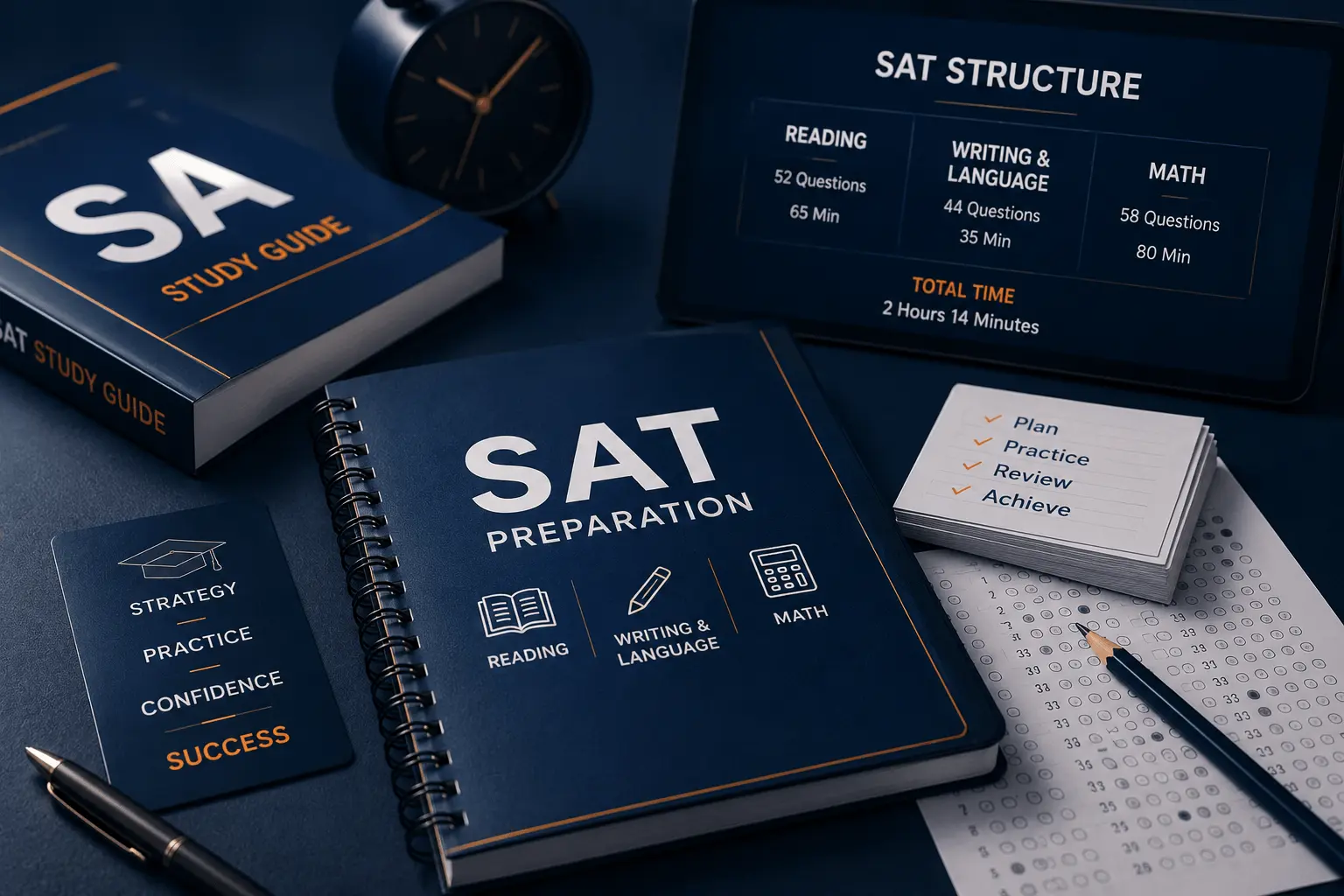
Know the Test Before Trying to Master It.
54
QUESTIONS
Reading and Writing
64 minutesTwo 32-minute modules
44
QUESTIONS
Math
70 minutesTwo 35-minute modules
98
TOTAL QUESTIONS
Complete Test
2 hours 14 minutesPlus the scheduled break
2×2
ADAPTIVE MODULES
Multistage Adaptive Format
Performance matters early.The second module in each section reflects performance in the first module.
Our SAT Preparation Process
Diagnose First. Prioritize Second. Practice With Purpose.
SAT preparation should not treat every skill as equally urgent. We identify where the most attainable points are being lost and build the plan around those opportunities.
THE PRIORITY QUESTION
Which changes are most likely to produce the next 50 points?
BASELINE
Establish the Starting Score
Review current results, section scores, timing, and question-level patterns.
PRIORITIZE
Rank the Highest-Value Skill Gaps
Focus first on recurring errors and attainable points—not random practice.
TRAIN
Build Accuracy Before Speed
Strengthen content mastery and repeatable solution methods.
PRESSURE TEST
Apply Skills Under Timed Conditions
Use timed modules, strategic review, and full-length Bluebook practice.
REFINE
Measure, Adjust, and Repeat
Update the study plan based on new evidence and remaining score opportunities.
Different Score Ranges Require Different Priorities.
Rebuild the Highest-Impact Foundations
Emphasize core grammar, algebra, comprehension, and question interpretation.
Convert Knowledge Into Consistent Accuracy
Target recurring domains, pacing losses, and medium-difficulty questions.
Refine Precision and Advanced Strategy
Reduce avoidable misses and improve performance on harder module-two questions.
Protect Every Attainable Point
Focus on nuance, speed, difficult-question selection, and near-perfect consistency.
Numbers Matter. The Process Behind the Numbers Matters More.
EXAMPLE SCORE-GROWTH GOAL
1100 → 1300
+200 points
A goal like this is divided into section-specific gains, skill priorities, timed practice, and repeated measurement. Results vary by student and are never guaranteed.
Reading and Writing + Math
Two modules per section
Built around the student’s actual errors
Honest planning based on evidence
Frequently Asked Questions About SAT Preparation
Learn how personalized Digital SAT tutoring works and how a score-growth plan is developed.
Ask About Your Student’s Score →Can you guarantee a 200-point SAT increase?+
No ethical tutoring program can guarantee a specific score increase. A 200-point goal may be realistic for some students, but results depend on the baseline, timeline, attendance, practice consistency, academic foundation, and test-day performance.
Do you prepare students for both SAT sections?+
Yes. Preparation can include Digital SAT Reading and Writing, SAT Math, pacing, module strategy, Bluebook practice analysis, and test-day planning.
How do you identify where a student can gain points?+
We review section scores, missed-question patterns, content domains, timing decisions, and repeated error types to identify the highest-value priorities.
Do you use official Bluebook practice tests?+
Official full-length Bluebook practice can be incorporated into preparation, followed by detailed review and targeted skill work.
How long should a student prepare for the SAT?+
The ideal timeline depends on the starting score, target score, test date, weekly availability, and size of the skill gaps. Many students benefit from beginning several months before the intended test date.
Can you help a student who already has a high SAT score?+
Yes. Higher-scoring students often need precision work: difficult module-two questions, pacing refinement, nuanced grammar and reading decisions, and reduction of avoidable misses.
PRIVATE DIGITAL SAT PREPARATION
Stop Guessing What to Study. Build the Score Plan First.
Share the student’s current score, target score, test date, and section breakdown. We will help determine the highest-value next step.