
How to Read Your Kid's First Progress Report
The first progress report of the year tells you less than it seems to, and more than you might think. Here's how to actually read one, what questions are worth asking, and how to talk to your child about it either way.
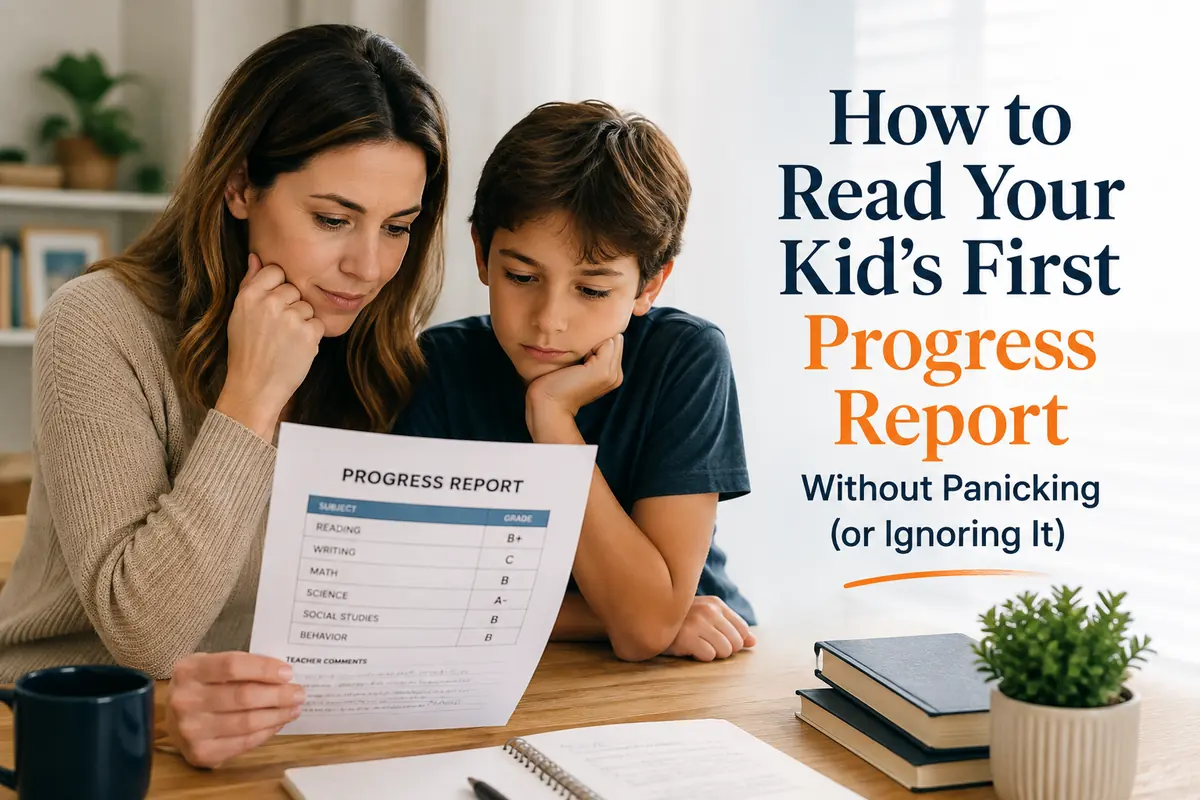
The first progress report of the year lands differently than every report after it. There's no baseline yet — no "compared to last time" to fall back on — so a single letter grade or checked box can feel like it's telling you something much bigger than it actually is. Some parents glance at it, feel a flash of relief or worry, and move on without really reading it. Others study every line and end up more confused than when they started. Both reactions are understandable, and neither one gets you very far.
Here's the thing worth knowing before you open the envelope or log into the parent portal: a progress report is a snapshot, not a verdict. It reflects a few weeks of classwork, often before a full unit has even been taught, and it's built to flag a direction, not to summarize a whole year. The National PTA's own guidance to families, published on its EdNavigator family resource hub, puts it plainly: report cards exist for parents, and if one is confusing, that's a reason to ask the teacher to explain it — not a reason to guess.
There's also a real gap worth knowing about between what parents assume and what these reports often show. According to Learning Heroes, a national nonprofit that studies parent understanding of student achievement, roughly 90 percent of parents believe their child is performing at or above grade level, even though only about a third of students nationally are proficient in reading and math on independent measures — a mismatch reported by National PTA's own family magazine. That's not a reason to distrust every good grade. It's a reason to read a progress report as one data point, not the whole picture.
In This Article
What a Progress Report Actually Measures
Most progress reports are built from a narrow slice of the school year: a handful of quizzes, some classwork, a project or two, and a teacher's day-to-day impression of effort and participation. Depending on your school's system, it may be letter grades, numeric scores, or a set of checkboxes like "meeting expectations," "developing," or "needs improvement." None of these formats are trying to summarize your child as a student. They're trying to flag, early, whether the current trajectory looks fine or needs a course correction.
That distinction matters because a progress report is fundamentally different from a report card. A report card usually comes after a full grading period and reflects a more complete picture. A progress report is designed to arrive earlier and say, in effect, "here's where things stand so far" — which is exactly why it's most useful read as a check-in, not a conclusion.
A progress report tells you where things stand right now, with several weeks of the grading period still ahead. Its job isn't to be final. It's to give you enough time to act while there's still time for it to matter.
What It Doesn't Tell You
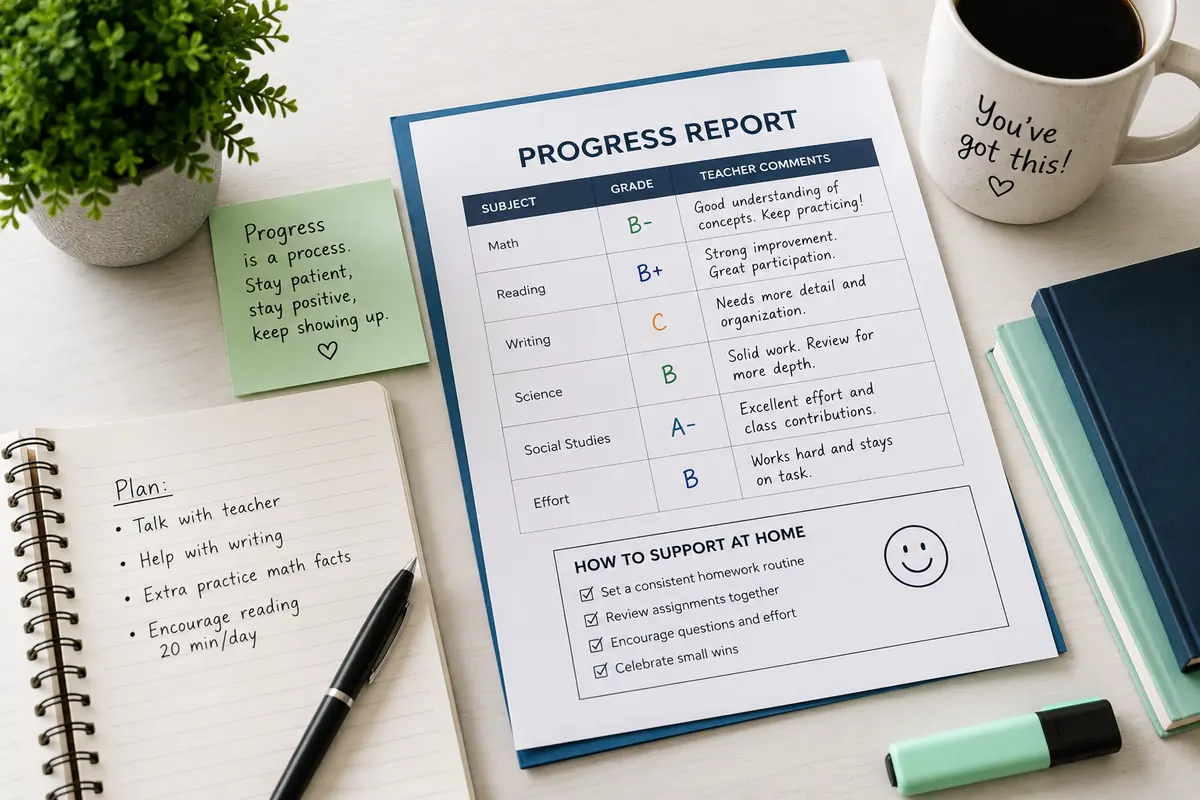
It's just as useful to know what a progress report leaves out. It generally won't reflect material that hasn't been taught yet, so a "developing" mark in a skill scheduled for later in the term may simply mean exactly that — it's coming, not that your child is behind. It also won't show how a grade compares to state or national benchmarks, since most classroom grades are a mix of academic performance, effort, and behavior rather than a pure measure of mastery.
This is part of why the mismatch between parent perception and actual proficiency data exists in the first place. As National PTA's family publication notes, teachers often have access to far more detailed data — interim assessments, formative quizzes, in-class observations — than what makes it onto the progress report itself. The report is a summary, and like any summary, it leaves things out.
What a Progress Report Can Tell You
- A general direction — on track, or worth watching
- Which subject, if any, needs a closer look
- How your child is doing with routine and participation
- A starting point for a specific conversation with the teacher
What It Usually Can't Tell You
- Whether your child is "behind" in any broader sense
- How this compares to state or national benchmarks
- The specific concept behind a low mark, without more detail
- The full picture — that comes from combining it with other information
How to Actually Read It
The most useful approach is to read it once on your own before reacting, then a second time with a specific plan for what you'll do with what you find. National PTA's family guidance recommends going through the report calmly and identifying what you're proud of and what concerns you before bringing your child into the conversation — partly so you're not processing your own reaction in front of them.
Read it once, privately, before reacting
Give yourself a few minutes to take in the whole picture before deciding how you feel about it. A first reaction to one number is rarely the same as a considered read of the full report.
Look for a pattern across subjects, not one number
A single lower mark in an otherwise strong report usually points to something specific and fixable. A pattern across several subjects is more often about something broader — sleep, focus, a schedule change, or something going on outside the classroom.
Separate effort and behavior marks from academic ones
Many progress reports track participation, homework completion, or "learning skills" like organization separately from academic performance. A student can be strong academically but still get flagged for something like turning in work late, which points to a very different kind of fix.
Note anything you don't understand, and ask
If a comment, code, or checkbox doesn't make sense, that's worth a direct question to the teacher rather than a guess. Report cards vary widely between schools and districts, and there's no reason to interpret an unfamiliar system on your own.
Big Swings vs. Small Dips
Not every lower mark deserves the same level of attention. A small dip in one subject, especially early in the year, is often just noise — a harder unit, an unfamiliar format, or a slow start to a new teacher's expectations. A large swing is a different story. According to EdNavigator's parent guidance, one of the clearest things worth watching for is a big jump in either direction — a sudden move from C's and D's to A's, or the reverse — since dramatic shifts are more likely to reflect something real than a routine subject-to-subject dip.
How Much Attention Different Patterns Deserve
Talking to Your Child About It
How this conversation goes often matters more than what the report actually says. The goal is to keep your child talking to you honestly about school for years to come, which means the first progress report conversation is setting a pattern, not just addressing one report.
The American Academy of Pediatrics, through its HealthyChildren.org family communication guidance, emphasizes acknowledging a child's feelings directly rather than immediately problem-solving or correcting — for example, naming that a low grade might feel discouraging before jumping straight to a plan. Kids are more likely to engage honestly about a tough grade when they feel heard first.
"How do you think this one went?" — asked before you say anything about the report yourself — tells you how aware your child already is of their own performance, and it's a far better opener than leading with your own reaction.
It's worth deliberately looking for something to acknowledge before addressing any concerns, and worth resisting the urge to treat a report card as a punishment. As Scholastic's parent guidance on report cards puts it, a low mark was earned over the course of the marking period, not handed down arbitrarily — which means the more productive response is usually a specific plan, not a consequence.
Questions Worth Asking the Teacher
If something in the report doesn't sit right, a short, specific email is almost always more useful than waiting for the next scheduled conference. Most teachers would rather hear from you now, while there's still runway left in the grading period, than after the final grade is locked in.
Parent email template
Hi [Teacher's Name], I looked over [student's name]'s progress report and wanted to check in about [specific subject or mark]. Could you help me understand what this is based on, and whether there's a specific skill or habit worth focusing on at home before the next grading period? Happy to set up a quick call if that's easier.
- What is this particular mark based on — a specific assignment, or an overall impression?
- Is this an area most students are finding difficult right now, or is it more specific to my child?
- Is there one concept or habit that, if we focused on it, would make the biggest difference?
- How will progress be reflected the next time a report goes home?
What to Do With a Low Mark
Once you understand what a low mark is actually about, the next step is usually smaller and more specific than it feels in the moment. A single low mark in one subject rarely calls for a dramatic response — it calls for a clear, small plan your child can see and buy into.
What a reasonable plan usually includes
- One specific area to focus on, not a general "try harder"
- A concrete, low-pressure way to practice it at home or with a teacher
- A realistic timeline — most schools have another check-in before the report card
- Your child's own input on what they think would help
This is also where it's worth separating a punitive response from a supportive one. Taking away privileges or adding pressure rarely changes the underlying skill gap — it just adds stress on top of it. A specific plan, built with your child rather than imposed on them, tends to produce a very different next progress report.
When Outside Support Actually Helps
Not every low mark needs outside help — many resolve with a short conversation with the teacher and a few weeks of focused attention at home. But when the same subject shows up as a concern across more than one grading period, or when a parent and teacher both agree a specific skill needs rebuilding rather than just more practice, that's usually the point where targeted academic support makes the most difference.
The advantage of addressing it now, right after the first progress report, is timing. There's still a full grading period ahead, which means there's real room for a specific gap to close before it shows up on the actual report card. At Academy of Tutoring, sessions are built around identifying exactly what a progress report flagged and closing that specific gap — across math, English, science, history, and test preparation for grades 4–12.
Final Thought: One Report, Not the Whole Story
The first progress report of the year is designed to be a checkpoint, not a conclusion. It arrives early enough that almost anything it flags is still fixable, and calm enough attention now tends to prevent the kind of scramble that happens when a concern isn't noticed until the semester grade.
Frequently Asked Questions
Is a progress report the same as a report card?
No. A progress report is an earlier, partial check-in, usually covering just a few weeks. A report card typically comes at the end of a full grading period and reflects a more complete picture.
Should I be worried about one low mark on the first progress report?
Usually not on its own. A single lower mark, especially early in the year, often reflects a harder unit or unfamiliar expectations. What's worth watching is whether the same subject shows up again on the next check-in.
What if I don't understand how the grading or marking system works?
Ask the teacher directly. Grading systems vary widely between schools and even between teachers, and there's no reliable way to guess at an unfamiliar system's meaning.
Should I talk to my child before or after I've processed the report myself?
After. Reading it privately first gives you a chance to react on your own time, so the conversation with your child can start calmly rather than in the moment of your own surprise or disappointment.
How do I bring up a low mark without it feeling like a punishment?
Lead with a specific question about how your child thinks it went, acknowledge how they're feeling about it, and move toward a small, concrete plan together rather than a consequence.