The Parent-Teacher Conference
Most parent-teacher conferences are brief — often around 10 to 30 minutes. That's not a lot of time to understand a whole semester of your child's school life — so how you spend it matters more than how long it lasts.
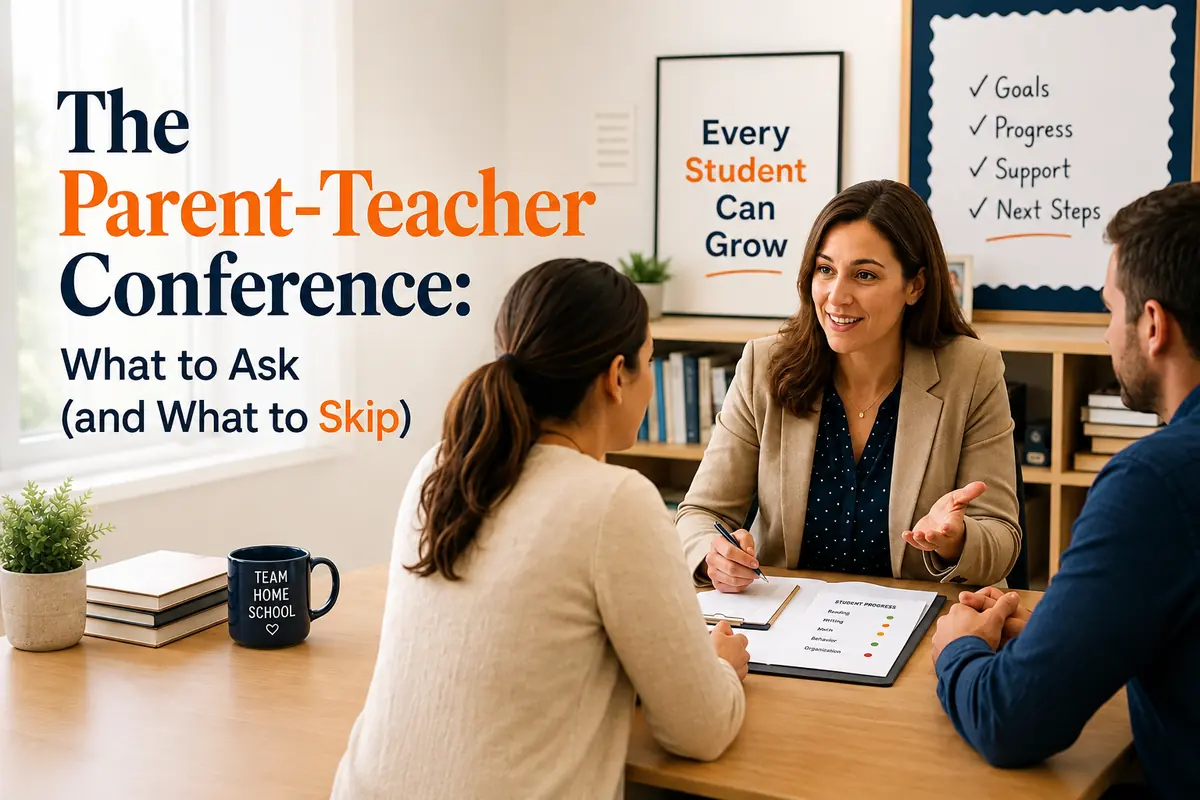
Parent-teacher conferences carry a strange kind of pressure. You've been waiting weeks for a real conversation about how your child is actually doing, and then you get a short window to have it — sometimes less, if the school is running behind. It's easy to walk out feeling like you didn't get to the things that actually mattered, or worse, to spend the whole meeting nodding along to information you already knew from the first progress report.
The good news is that conference time is far more useful when it's planned in advance. According to U.S. Department of Education: Family Partnership and Engagement
National PTA: Parent-Teacher Conference Guide
American Academy of Pediatrics / HealthyChildren.org: The Parent-Teacher Conference
EdNavigator, a national nonprofit focused on helping families navigate school systems, conversations with a child's teacher are typically brief — which means a handful of well-chosen questions will get you far more useful information than a long, unfocused list ever could. The nonprofit Nemours KidsHealth, a widely trusted source for family and child health guidance, makes a similar point: an effective conference is a two-way conversation, not a one-way report, and the parents who prepare a little in advance tend to leave with far more than the parents who walk in cold.
This guide walks through how to prepare, which questions are worth your limited time, which ones are usually better left for a different conversation, how to involve your child beforehand, and what to actually do with what you learn once the conference is over. The U.S. Department of Education's family partnership resources likewise emphasize strong parent-school communication as part of supporting student success.
In This Article
Why These Short Meetings Matter So Much
It's tempting to treat a parent-teacher conference as a formality — a box to check on the school calendar. In practice, it's one of the only times all year when a parent gets dedicated, one-on-one time with the person who spends more waking hours with their child than almost anyone else outside the family. A teacher sees things a parent structurally cannot: how a child behaves in a group, how they handle frustration in front of peers, whether they raise their hand or hang back, how they compare to where most students their age typically are.
California State PTA's guidance for families describes the conference as a chance for parents and teachers to work together as a team on behalf of the student — not a one-directional evaluation, but a genuine exchange where the parent brings context about the child at home and the teacher brings context about the child at school. Neither half of that picture is complete without the other, which is exactly why the short time available is worth using deliberately rather than letting the teacher simply narrate a set of grades you may have already seen on a progress report.
A conference is short by design. The parents who get the most out of it aren't the ones who ask the most questions — they're the ones who walk in with two or three specific, prioritized questions and are ready to let the rest go if time runs short.
Before the Conference: How to Prepare
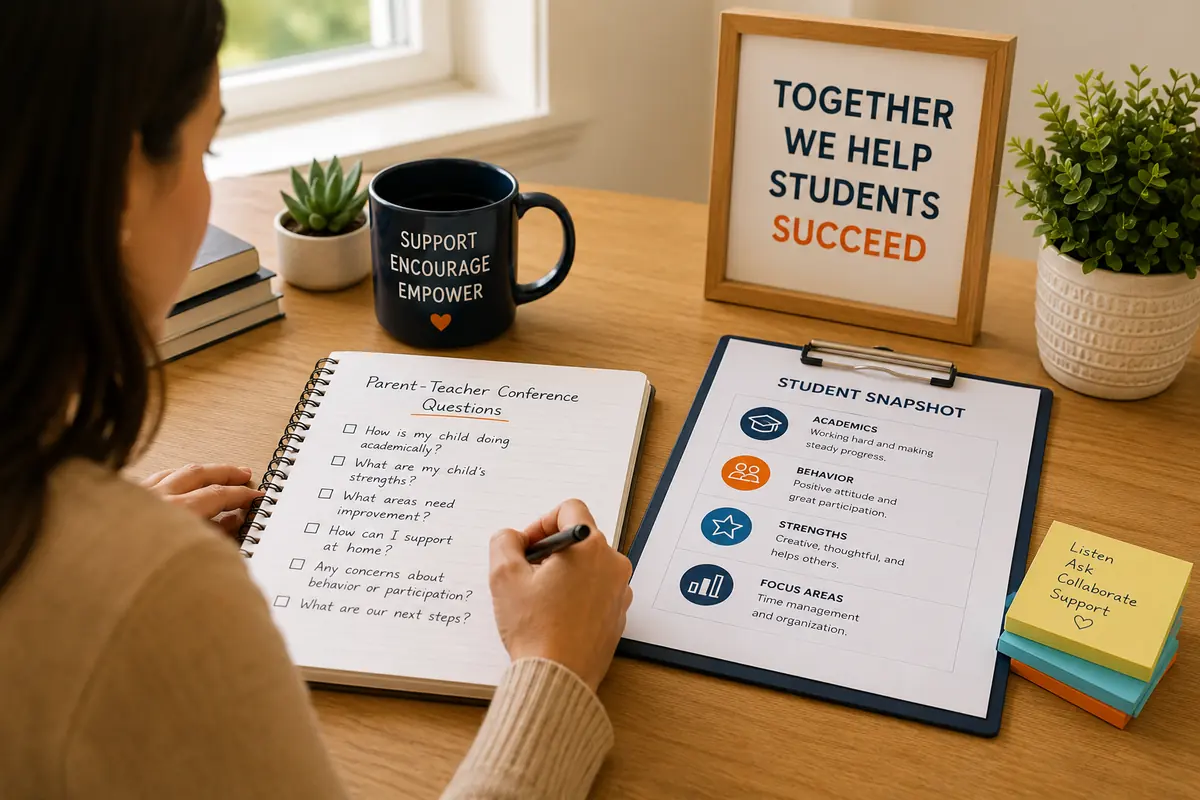
The single highest-leverage thing a parent can do before a conference is write questions down in advance, in order of priority. The National PTA Parent-Teacher Conference Guide recommends reviewing your child's work, asking your child what they want discussed, and arriving with a written list of questions or concerns. Cornell Cooperative Extension's family guidance on conference preparation recommends parents write down their questions and concerns beforehand, discuss them with a spouse or co-parent if both will attend, and bring a few relevant notes about the child's home life, temperament, or habits that might help the teacher see the fuller picture.
Review what you already have
Pull up the most recent report card, progress report, or any assessment results before the meeting. There's no reason to spend limited conference time restating information the teacher already sent home — use that time to go deeper on what it means.
Write down two or three priority questions
Not ten. Not a mental list. A short, written list, ranked by importance, so if time runs out you've already covered the things that matter most.
Talk to your co-parent beforehand, if applicable
If both parents or caregivers are attending, a quick check-in beforehand on shared concerns and priorities prevents the conference itself from becoming the first time you're comparing notes.
Decide what you're prepared to share
Relevant context about your child's home routine, sleep, recent changes, or stress can genuinely help a teacher understand a pattern they're seeing in class. You don't need to share everything — just what's actually relevant to how your child is doing at school.
Involving Your Child Beforehand
Depending on your child's age, a short conversation before the conference can significantly change what you get out of it. Asking your child how they think they're doing, which subjects feel easiest or hardest, and whether there's anything they'd want you to ask the teacher gives you real material to work with — and it also signals to your child that the conference is about supporting them, not just adults talking about them behind a closed door.
Quick questions to ask your child first
- How do you think this year is going so far?
- What's the class or subject you feel most confident in right now?
- Is there anything that's felt harder than you expected?
- Is there anything you'd want me to ask your teacher?
The American Academy of Pediatrics' HealthyChildren.org guidance also recommends asking your child beforehand if there is anything they want discussed and reassuring them that the conference is meant to help, not criticize. For older students in middle and high school, it's often worth asking directly whether they'd like to be part of the conference itself, or at least debriefed afterward. Their perspective on their own learning becomes increasingly relevant with age, and involving them appropriately tends to build the kind of ownership that makes any resulting plan more likely to stick.
Questions Worth Asking
With limited time, the most useful questions tend to fall into a few categories: academic performance and growth, learning habits and study skills, social-emotional wellbeing, and practical next steps. Rather than trying to cover everything, pick one or two from each category based on what matters most for your child right now.
On academic performance
- How does my child's current work compare to where most students are at this point in the year?
- Are there specific skills or concepts you'd like to see my child strengthen before the next report?
- Can you show me an example of strong work and an example of an area for growth?
On learning habits and study skills
- Does my child seem to have the organization and time-management skills expected at this grade?
- How does my child handle a difficult assignment — do they ask for help, or do they tend to give up quietly?
- What's one specific thing we could practice at home that would make the biggest difference?
On social and emotional wellbeing
- Does my child seem to like school? Why or why not, in your view?
- How does my child interact with classmates during group work or free time?
- Is there anything about my child's mood or behavior in class that's changed recently?
On next steps and follow-up
- How would you prefer I reach out if something comes up before our next scheduled conference?
- Is there a natural check-in point — a quiz, project, or progress report — worth watching for?
- Is there anything you wish more parents knew or asked about, that would help you support the class better?
Nemours KidsHealth's guidance for families notes that even a simple, open-ended question — asking whether a child likes school, and why or why not — can surface a surprising amount of useful information in a single answer, since it invites the teacher to speak more broadly than a narrow academic question would. Similarly, the nonprofit Understood.org, which specializes in learning and thinking differences, recommends going in with a short, prioritized list precisely because most conferences run only 10 to 15 minutes — not enough time to cover everything, but enough time to cover what matters most.
Questions Worth Skipping
Just as important as knowing what to ask is knowing what to leave for a different setting. A short conference is not the right venue for every kind of conversation, and trying to force certain topics into a 15-minute window often means neither side gets a satisfying answer.
Good Fit for a Short Conference
- Specific, focused questions about current performance
- A request for one or two concrete things to work on
- Clarifying something confusing from a report or grade
- A quick read on social and emotional wellbeing
Better Saved for a Separate Conversation
- A detailed discussion of a suspected learning difference
- A complex family situation that needs real context and time
- A dispute over a specific grade or disciplinary action
- Broad curriculum or school-policy questions better suited for an administrator
This isn't about avoiding hard topics — it's about giving them the time they actually need. If a conference surfaces something that clearly deserves more than a few minutes, the most productive move is usually to say so directly: "This sounds like it needs more time than we have today — could we set up a follow-up call?" Most teachers will welcome that, since a rushed conversation about something serious rarely serves either side well.
Decoding Teacher Language
Education is full of jargon that can make a straightforward concern sound vaguer than it is. EdNavigator's guidance specifically flags phrases like "with some hard work, she'll get there" as language that can sound reassuring on the surface while actually signaling a real struggle underneath. If a comment feels a little too smooth, it's worth gently pushing for specifics.
"Can you help me understand what that means in practice — how far off track is she, and what does the plan to get her caught up actually look like?" A direct, curious follow-up almost always produces more useful information than accepting a soft, general answer at face value.
It's also entirely reasonable to ask a teacher to rephrase anything that uses unfamiliar terminology or education-specific shorthand. Every teacher has had years of specialized training that comes with its own vocabulary, and there's no reason a parent should have to decode it alone in the moment.
During the Conference: Staying on Track
Once the conversation starts, a few small habits go a long way toward making the most of limited time. Taking brief notes helps you remember specifics afterward, since it's easy for details to blur together if you're meeting with several teachers back to back at a middle or high school conference night.
Lead with your top priority question
Don't save the most important question for last in case time runs short. Ask it early, while there's still a full conversation's worth of time to explore the answer.
Ask to see actual examples of work
A specific piece of graded work tells you more than a general description ever could, and it gives you something concrete to reference later at home.
Take brief notes
A few words capturing the teacher's key points are enough to jog your memory later — you don't need a transcript, just enough to follow up accurately.
Confirm the plan before you leave
If the conversation lands on a specific next step, repeat it back in your own words before the meeting ends, so there's no ambiguity about what happens next.
After the Conference: Following Through
What happens in the days after a conference often matters more than the conference itself. California State PTA's family guidance recommends a simple follow-through routine once an action plan is in place: watch your child's behavior, check in on classwork and homework, ask how your child feels about the work, and stay in touch with the teacher as progress unfolds — including expressing appreciation when things improve, not just flagging concerns when they don't.
A simple follow-up routine
- Share a short, warm summary with your child — what you learned, and one thing to work on together
- Put any agreed check-in date on your calendar so it doesn't quietly slip
- Watch for the specific pattern discussed, not just grades in general
- Send a brief note to the teacher if you notice real progress — not only if something goes wrong
This last point is easy to overlook but genuinely valuable. Teachers hear from parents far more often when something is wrong than when something is going well, and a short note of appreciation tends to strengthen exactly the kind of open communication that makes the next conference, or the next concern, easier to raise.
When the Conference Points to More Support
Sometimes a conference surfaces something more specific and ongoing than a quick home routine can fully address — a particular concept in math that hasn't clicked, a persistent gap in reading fluency, or study skills that need more structured practice than a busy evening at home allows. That's a natural, low-drama outcome of a good conference, not a sign that anything has gone wrong.
The advantage of acting on this soon after the conference is timing, just as it is with a progress report: there's real time left in the term for a specific, well-defined gap to close before it becomes something larger. At Academy of Tutoring, sessions are built around exactly the kind of specific concept or skill a teacher might flag in a conference — across math, English, science, history, and test preparation for grades K–12.
Final Thought: A Short Meeting, Used Well
Fifteen minutes isn't much time to understand a whole semester of school. But a parent who walks in with two or three clear priorities, listens for the specifics behind general reassurances, and follows through afterward will consistently get more out of that short window than a parent who walks in with a long, unfocused list and no plan for after.
Frequently Asked Questions
How long does a typical parent-teacher conference last?
Many run around 10 to 30 minutes per family, though this varies by school and grade level. Planning a short, prioritized list of questions ahead of time makes a much bigger difference than the exact number of minutes available.
Should my child attend the conference?
It depends on age and school norms. For younger children, most conferences are parent-and-teacher only. For middle and high schoolers, some families find it valuable to include the student directly or at least debrief with them right after.
What if I don't understand something the teacher says?
Ask them to rephrase it in plain language. Education terminology varies widely, and there's no expectation that parents already know it — teachers are generally glad to clarify.
What if the conference surfaces a bigger concern than we have time for?
Say so directly and ask for a follow-up call or meeting. A rushed conversation about something significant rarely serves either the parent or the teacher well, and most teachers welcome the request for more dedicated time.
Is it okay to request a conference outside the scheduled ones?
Yes. If your school doesn't offer regular conferences, or if something comes up between scheduled ones, you can request a meeting at any point in the year.
What should I do if the meeting mostly repeats what was already on the progress report?
Use your prepared questions to go deeper rather than accepting a restatement of familiar information — ask for specific examples, a comparison to grade-level expectations, or one concrete thing to focus on next.