The Skills Schools Can’t Teach Fast Enough Anymore
Academic knowledge still matters. But students increasingly need something more: the ability to question information, communicate clearly, adapt to new situations, solve unfamiliar problems, and keep learning long after the lesson ends.
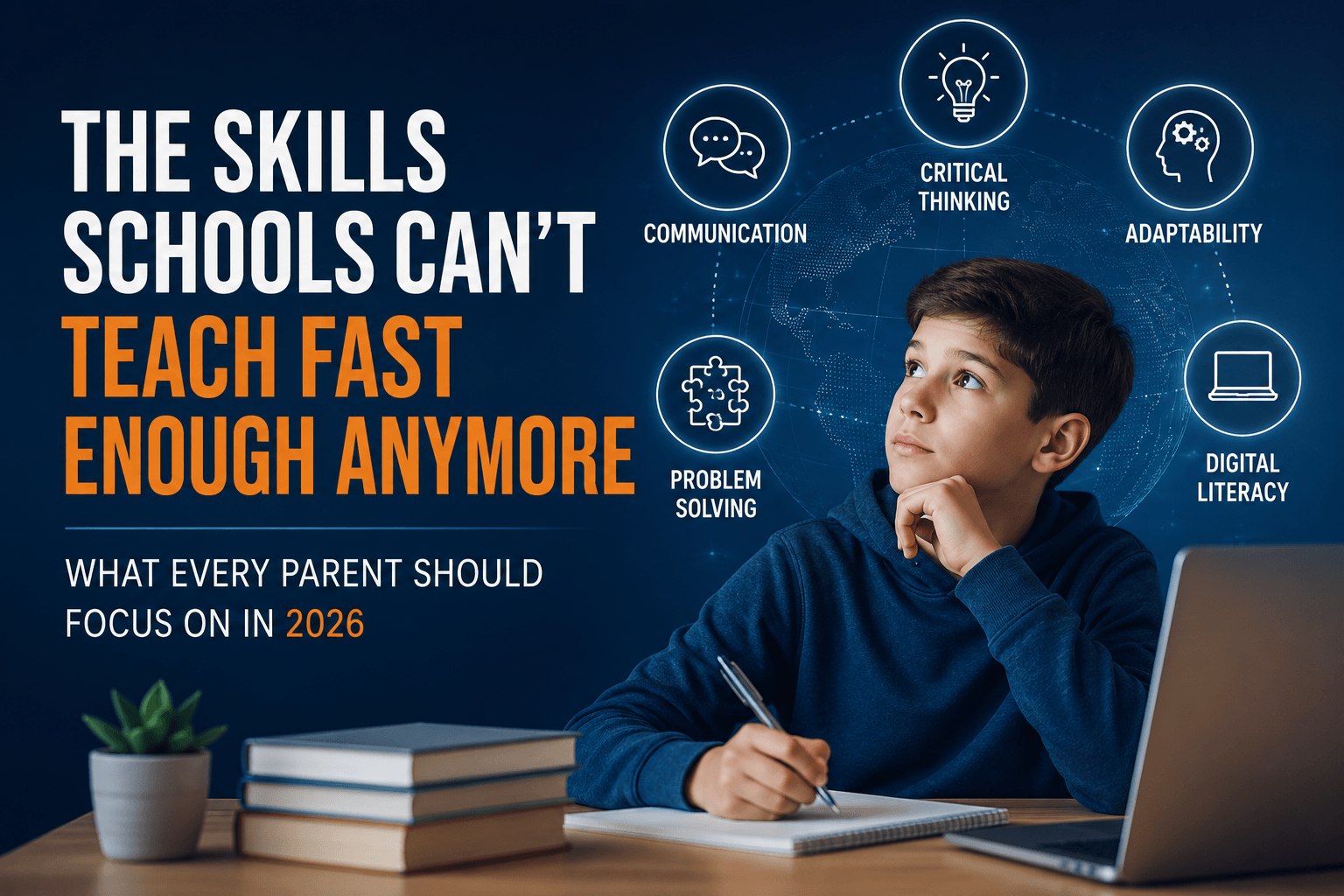
Schools were designed to teach essential knowledge: reading, writing, mathematics, science, history, and the habits students need to participate in society. Those foundations remain important. But the world students are entering now changes faster than most school systems can update courses, train teachers, or rewrite standards.
Artificial intelligence can generate explanations, summarize information, write code, create images, and answer questions in seconds. Careers are changing. Information is abundant, but not always accurate. Students are expected to collaborate across technology, evaluate online claims, communicate with different audiences, and learn new tools throughout their lives.
That does not mean schools are failing. It means schools are being asked to prepare students for a moving target. The World Economic Forum’s Future of Jobs Report 2025 identifies technology literacy, creative thinking, resilience, flexibility, curiosity, and lifelong learning among the skills expected to grow in importance. The OECD Learning Compass 2030 similarly emphasizes student agency, well-being, knowledge, skills, attitudes, and values.
The goal is not to predict one perfect future career. It is to help students become the kind of learners who can adapt when careers, tools, and expectations change.
In This Article
Why Schools Cannot Update as Fast as the World Changes
Schools operate on long timelines. Curriculum standards are debated, approved, funded, and implemented over years. Teachers need training. Textbooks and assessments must be updated. Meanwhile, the tools students use can change several times within one school year.
A student may learn one platform in September and encounter a different one by spring. A writing assignment that once measured independent composition may now require teachers to consider whether AI was involved. Research skills have changed because students no longer struggle to find information; they struggle to decide which information deserves trust.
This creates an important distinction between content and capability. Content includes the facts, rules, formulas, and concepts students learn. Capability is what students can do with that knowledge: question it, connect it, explain it, apply it, and revise their thinking.
Traditional Academic Strength
- Remembering key information
- Following familiar procedures
- Completing assigned tasks
- Preparing for known test formats
- Producing the expected answer
Future-Ready Strength
- Evaluating unfamiliar information
- Choosing among multiple strategies
- Asking better questions
- Explaining reasoning clearly
- Learning from mistakes and change
1. Critical Thinking: Knowing What Deserves Trust
Critical thinking is not simply disagreeing with information. It is the disciplined ability to examine evidence, notice assumptions, compare explanations, and decide whether a conclusion is justified.
This skill matters because students encounter polished information everywhere. A confident answer from an AI tool, an edited social-media video, or a professional-looking website may still be incomplete or misleading. Students need to ask: Who created this? What evidence supports it? What is missing? Can the claim be verified elsewhere?
UNESCO’s AI Competency Framework for Students emphasizes preparing students to use and help shape AI responsibly. That requires more than knowing how to type a prompt. It requires judgment.
When your child shares a surprising fact, do not immediately confirm or reject it. Ask, “How could we check whether that is true?” The verification process teaches more than the answer.

2. Communication: Turning Thoughts Into Meaning
Students may have excellent ideas but struggle to explain them. Communication includes writing clearly, speaking confidently, listening carefully, asking useful questions, and adjusting a message for different audiences.
In school, communication affects essays, presentations, group projects, class participation, and even mathematics. A student who can explain why a solution works usually understands it more deeply than a student who only produces the correct answer.
Technology makes communication faster, but not automatically better. Short messages, autocorrect, AI-generated sentences, and constant switching between platforms can make it easier to communicate without thinking carefully about tone, structure, evidence, or clarity.
Simple Ways to Build Communication
- Ask students to summarize an idea without notes
- Have them explain a decision and defend it respectfully
- Encourage complete emails instead of one-line messages
- Discuss how the same idea should sound to a friend, teacher, or employer
- Practice listening before responding
3. Adaptability and Resilience: Recovering When the Plan Changes
Students are often rewarded for getting the answer right. Life frequently rewards the ability to respond when the first answer does not work.
Adaptability means changing strategy without abandoning the goal. Resilience means continuing after disappointment while still learning from what happened. These skills matter during difficult classes, group conflict, changing technology, college transitions, and future careers.
Parents sometimes protect children from frustration because they want to preserve confidence. But confidence grows when students experience manageable difficulty and discover that they can respond effectively.
Skills That Become More Valuable as Change Accelerates
4. Digital and AI Literacy: Using Technology Without Being Used by It
Digital literacy once meant knowing how to search, type, and use common software. Today it includes understanding privacy, algorithms, online persuasion, misinformation, AI limitations, copyright, data, and the emotional design of platforms.
Students should know that digital tools are designed by people and organizations with goals. A recommendation feed is not a neutral list. An AI answer is not a verified source. A popular post is not automatically accurate.
Common Sense Media’s AI resources for families help parents discuss safety, trust, and responsible use. The goal should not be fear of technology. It should be informed use.
Technology may assist the work, but the student must remain able to explain the reasoning, verify important claims, and complete similar work independently.
5. Problem Solving: What to Do When the Path Is Not Obvious
Many school problems are structured. Students are given the information, the method was recently taught, and one correct answer is expected. Real problems are often unclear. Important information may be missing. Several solutions may be possible. The first attempt may fail.
Problem solving requires students to define the problem before solving it. They need to separate what they know from what they assume, generate options, test a strategy, and revise.
Parents can build this skill by resisting the urge to solve every practical problem immediately. Planning a family outing, comparing purchases, organizing a weekly schedule, or fixing a small household issue can become a real-world reasoning exercise.
6. Creativity and Curiosity: Producing More Than the Expected Answer
Creativity is not limited to art. It includes combining ideas, imagining alternatives, asking unusual questions, and seeing possibilities that are not immediately obvious.
Curiosity drives learning before grades or requirements enter the picture. Students who remain curious are more likely to explore difficult subjects, make connections, and continue learning after formal education ends.
The World Economic Forum identifies creative thinking and curiosity among the skills rising in importance. These qualities are difficult to build through constant correction or overscheduling. Students need room to investigate, make imperfect attempts, and follow questions that do not have immediate rewards.

7. Student Agency: Learning to Direct Their Own Growth
Student agency means more than independence. It is the ability to make meaningful choices, set goals, monitor progress, and take responsibility for the next step.
The OECD’s Future of Education and Skills 2030 project places student agency at the center of preparing young people to thrive. Students need opportunities to act rather than only comply.
A student with agency can say, “I do not understand this part yet, so I need a different explanation,” or “This study method did not work, so I will change it before the next test.” That is very different from waiting for an adult to identify and solve every problem.
Let the Student Name the Goal
Adults can guide the conversation, but students should practice describing what they want to improve and why it matters.
Choose One Measurable Action
Replace broad goals such as “do better” with specific actions such as completing three practice sets or revising one paragraph carefully.
Review the Strategy, Not Only the Result
Ask what worked, what did not, and what should change next time.
Transfer Responsibility Gradually
Support should decrease as the student becomes more capable of planning and checking independently.
What Parents Can Focus On at Home
Parents do not need to become teachers of every future skill. The home environment can reinforce them through ordinary routines.
- Ask children how they reached an answer, not only whether it is correct
- Discuss news, advertising, online claims, and evidence
- Give students responsibility for planning part of their week
- Encourage reading beyond assigned schoolwork
- Allow manageable mistakes and require reflection afterward
- Invite children to solve real family problems
- Use technology together and discuss its limitations
Academic support can also reinforce these skills when it goes beyond answer completion. A strong tutor asks students to explain, compare strategies, correct errors, and become more independent. Academy of Tutoring’s subjects page outlines support across math, English, science, and test preparation, while the Why Us page explains the company’s approach.
Final Thought: Prepare Students for Change, Not One Prediction
No parent, teacher, or report can predict exactly which tools or careers will dominate when today’s students become adults. That uncertainty is not a reason to panic. It is a reason to focus on durable abilities.
Students who can think critically, communicate clearly, adapt, solve problems, use technology responsibly, and direct their own learning will be better prepared for many possible futures.
Schools remain essential. But families, tutors, communities, and students themselves all have a role in building the capabilities that formal systems cannot always teach quickly enough.
Frequently Asked Questions
What are the most important future skills for students?
Critical thinking, communication, adaptability, digital and AI literacy, problem solving, creativity, curiosity, resilience, collaboration, and student agency are among the most durable skills.
Do academic subjects still matter if AI can answer questions?
Yes. Students need knowledge to recognize whether an answer makes sense, ask strong questions, connect ideas, and use tools responsibly. AI makes strong foundations more important, not less.
How can parents teach critical thinking?
Ask children to explain evidence, compare sources, consider alternative explanations, and verify surprising claims before accepting them.
Should children learn how to use AI?
Yes, with age-appropriate guidance. Students should understand both the benefits and limitations of AI, including accuracy, privacy, bias, and the need to verify important information.
Can tutoring help build future-ready skills?
Yes, when tutoring emphasizes explanation, reasoning, communication, mistake analysis, and independence rather than simply completing assignments.
Help Your Child Build Skills That Last
Personalized support can strengthen academic foundations while helping students become more confident thinkers, communicators, and independent learners.
Schedule a Consultation