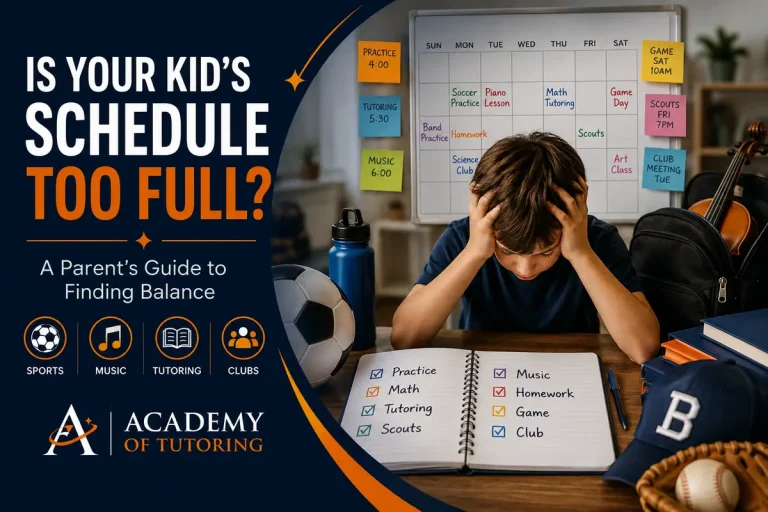
Many students in grades 4–8 don’t struggle because they “can’t learn.” They struggle because school quietly shifts expectations — and students are suddenly required to manage skills they were never explicitly taught.
Planning, organizing, studying, pacing work, preparing for tests, and working independently become assumed skills. For many children, this shift happens almost overnight.
On the surface, things may look fine. Homework gets done (eventually). Grades aren’t terrible. Teachers say your child is capable. But at home, school feels exhausting. Confidence is shaky. Progress feels slower than it should — and stress creeps into evenings.
This guide breaks down how academic challenges quietly build during the middle grades, why capable students often feel overwhelmed, and what parents can do to support growth without turning homework into a nightly battle.
Quick jump
- 1) When School Stops Teaching “How” to Learn
- 2) Why Effort Alone Stops Working
- 3) The Hidden Cost of Poor Organization
- 4) Why Confidence Drops in Middle Grades
- 5) How Homework Becomes a Stress Trigger
- 6) The Independence Gap
- 7) When Parents Become the “Homework Police”
- 8) What Real Academic Support Looks Like
- Fast FAQ
📚 When School Stops Teaching “How” to Learn
In the early elementary years, learning is highly scaffolded. Teachers model how to start assignments, how to organize thinking, how to check work, and how to fix mistakes.By grades 4–8, that scaffolding fades — but expectations rise rapidly. Students are expected to manage more work, across more subjects, with less guidance.
They are suddenly expected to:
- Track assignments independently
- Understand multi-step directions
- Study for assessments without guidance
- Recognize mistakes and self-correct
⚙️ Why Effort Alone Stops Working
When academics become harder, students often respond by trying harder. They sit longer, reread notes, and spend more time “studying.”Eventually, effort without strategy reaches a ceiling. Students may:
- Study longer but remember less
- Repeat the same mistakes
- Feel exhausted without improvement
In reality, many students rely on passive study methods that don’t build retention or understanding.
🗂️ The Hidden Cost of Poor Organization
Organization challenges are rarely obvious. They show up quietly as rushed work, forgotten instructions, or last-minute stress.Many students don’t know how to:
- Break assignments into manageable steps
- Estimate time realistically
- Prioritize tasks across subjects
🔻 Why Confidence Drops in Middle Grades
Confidence rarely disappears suddenly. It erodes over time as students experience repeated frustration or confusion.Students often respond by:
- Avoiding participation
- Rushing through work
- Choosing easier tasks
⏱️ How Homework Becomes a Stress Trigger
Homework stress is rarely about workload. It’s about uncertainty.Students feel overwhelmed when they don’t know:
- Where to start
- How long work should take
- What “finished” looks like
🚶 The Independence Gap
Independence is often expected before it is taught.Many students lack a reliable workflow for:
- Starting assignments
- Handling confusion productively
- Checking work before submission
⚠️ When Parents Become the “Homework Police”
When parents are forced into constant supervision, relationships suffer. Evenings become tense. Learning becomes emotional.This dynamic leads to:
- Frequent homework conflicts
- Parent exhaustion
- Student resistance
🌱 What Real Academic Support Looks Like
Effective academic support focuses on transferable skills — not just content.That includes:
- Planning and prioritization strategies
- Active study techniques
- Confidence built through measurable progress
❓ Fast FAQ
Is this normal for grades 4–8?
Yes. This is one of the biggest academic transitions students experience.Should parents step back or step in?
Support works best when it adds structure while building independence.How quickly can improvement happen?
Many families notice calmer homework routines within a few weeks.Want school nights to feel calmer?
With the right structure and guidance, learning can feel manageable again.